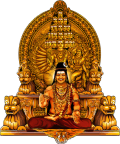
The Great Deluge
The Kailasonnata Shyamala Peetha Sarvajnapeetha originated from Paramaśiva when He himself manifested on Earth as Iraiyanar Sundareśvara after the great deluge in the sacred city of Madurai in South India. In the era of the Mahabharata, to revive the civilization Devi Mīnākśi brought all 56 kingdoms under one rule for the principles of enlightenment to reign. Iraiyanar Sundareśvar descended to rule along side Devi Mīnākśi, His eternal consort. When the enlightenment ecosystem was under the threat of extinction, it was revived by the great Incarnation, Thirujñana Sambandar. With him, the recorded lineage of Guru Maha Sannidhanams of the Madurai Aadheenam. This spiritual kingdom has spread the Vedic tradition and is the mother of numerous other traditional ancient monasteries, maintaining its’ sovereignty until after Indian independence. As it was divinely ordained by Devi Mīnākśi and Sundareśvara
Himself, The Supreme Pontiff of Hinduism Bhagavān Nithyānanda Paramashivam was selected and coronated as the 293rd Guru Maha Sannidhanam of this sacred unbroken tradition.
The history of this ancient civilization is a hidden treasure for humankind. At the turn of history, significant changes were taking place for the human inhabitants of Planet Earth and the dawn of a new era was quickly approaching.Thus far, life on Earth had been abundant in supernal realms, but humanity in the physical plane faced with extreme conditions on Planet Earth, was still in struggle. In order for the human civilization to flourish in the physical realm, Paramaśiva Himself assumed the human form. Recorded history of the Hindu civilization dates back 16,000 years. One of the major events of Hindu history that was recorded in the oldest historical texts, like Satapatha Brahmana, is the Great Deluge at the dawn of the Vaivasvata Manvantara. At this time, MahaViṣṇu warned the great king Satyavrata of an impending flood that would potentially harm the possibility of life on Earth.
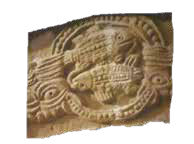
Viṣṇu brings Veda and Āgama from the dark energy during the manifestation of the Universe, in the form of fish – Matsyavatāra, and lands it on the Planet Earth. That is why the Pāndya Kingdom, the earliest kingdom, has a fish as their emblem. From Matsyavatāra, they took the emblem of fish. Because the most ancient civilization after the great deluge, Viṣṇu brings the whole Manu’s boat and Veda-āgamas and restarts the civilization. That has happened in Pāndya land. That is why the fish is the official government symbol of Pāndya Kingdom. Matsyavatāra happened twice. Once was to bring the Vedas and Āgamas out from the great deluge and give it to Brahma. That’s once. Second time was to pull the boat of the Manu from the great deluge – Pralaya, and restart the civilization. So when Viṣṇu restarted the civilization with the Manu’s boat, that was Pāndya Kingdom. That is why the Pāndya Kingdom has fish as their emblem, official emblem. Karaikal is the place where the boat was brought to the land by the Matsyavatāra. From there the whole Pāndya civilization started.”
Melwater Pulse 1A
Melwater Pulse 1A, According to Sh. Badrinarayan’s report (National Institute of Ocean Technology, India), on the melting of glacier waters, an earthquake in the Baramulla pass around 11,200 BCE, made the waters of the glacial lake in Kashmir Valley flow out and caused a great flood in the regions of Madra lva, Sindh and Gujarat.
Manu’s Ark & Matsyavatāra
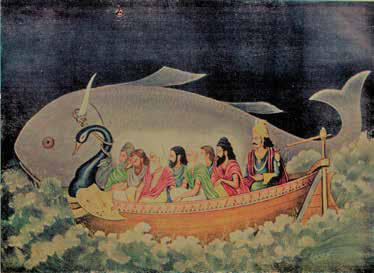
Maha Viṣṇu then promised that when this happens, a great ark will be sent to him to protect life on planet Earth. He instructed the king to collect all seeds, animals, and herbs and be ready to board the boat with the Sapta Ṛṣis including the great sage Agastya. He then promised that He himself would come to guide the ship.
On Earth many more years passed, but in time, as Maha Viṣṇu had foreseen, sea levels had risen and the clouds began pouring water unlike ever before seen. When an ark appeared before the King, he boarded the ship with all the items that he collected. Viṣṇu, as Matsyavatāra assumed the form of a humongous and divine fish once again and pulled the ship through
the waters of inundation.The place that Matsyavatāra safely harbored the ship was Madurai, where they would begin human civilization again. Thus began the history of the entire Tamil heritage and culture of Hinduism. At this primary stage, the founding members of the civilization wer Iraiyanar Sundareśvara and the Sapta Ṛṣis who survived the great flood. Out of gratitude for the Great Fish that saved them, the people of this primordial civilization raised their flag with the symbol of the Fish and came to be known as the Pāndya Civilization.
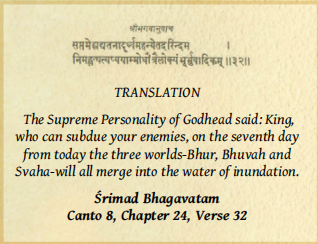
” The Supreme Personality of Godhead said: King, who can subdue your enemies, on the seventh day from today the three worlds-Bhur, Bhuvah and Svaha-will all merge into the water of inundation.
Śrimad Bhagavatam Canto 8, Chapter 24, Verse 32″
All Tamil texts, poems and other sacred literature refer to Iraiyanar as the greatest embodiment of Paramaśiva who lived on Earth and founded the basis of their living. The Iraiyanar Agapporul is the oldest of these texts and recognized as the most sacred treatise authored by Paramaśiva Himself while He was in this form. It was a sacred doctrine that contained the original instructions of Paramaśiva on artistic expression out of Oneness, as well the earliest guidance on language.
Historical Evidence
The Iraiyanar Agapporul, one of the most influential and oldest Tamil texts on living enlightenment, was written by Iraiyanar Sundareśvara Himself. The Iraiyanar Agapporul is dated to be from the first Sangam period between 11,266 – 6,826 BCE, multiple millennia before the happening of Devi Mīnākśi. Thus, Paramaśiva first established the civilization in Madurai as Bhagavān Sundareśvara. Many thousands of years later, Sundareśvara graced the kingdom once again as its King with Devi Mīnākśi.
Thirujñana Sambandar &
The Revival of Madurai Aadheenam
After the reign of Mīnākśi, and a period of abundance, the ecosystem was once again in need of revival. At this time, a divine child was born in the holy town of Sirkazhi, which was
then ruled by the Chola Kingdom. His name was Thirujñana Sambandar and he was an incarnation of Paramaśiva.Assuming the human body for only 16 years, Śri Thirujñana Sambandar’s mission was to rid this sacred land from the persecuting forces who have grossly mistranslated the Jain texts to spread violence.
In the 64 leelas, the divine plays of Lord Sundareśvara, one of the divine plays glorifies the acts of Thirujñana Sambandar for restoring the Madurai Aadheenam. Thirujñana Sambandar entered Madurai by healing the King Goon Pāndyan of his painful hunchback. Thirujñana Sambandar reinstated the Vedic Dharma in Madurai as the Guru Maha Sannidhanam of the Madurai Aadheenam and as the Raja Ṛṣi (the royal Saint Head of State) of the Pāndya Kingdom, guiding the King Goon Pāndyan.
Thirujñana Sambandar carried on the tradition of incarnations ruling as both the spiritual and state heads.
From Thirujñana Sambandar the recorded history of the Madurai Aadheenam begins. Till the revival of Madurai Aadheenam by Thirujñana Sambandar, there was no record of its history, though the Aadheenam itself existed much before his time.Its purpose was and has always been to govern the spiritual growth of the civilization, preserve the sacred sciences through persecution and guide the kings and their successors to achieve the greatest breakthroughs for humanity.The foundational philosophy of Madurai Aadheenam was the pure enlightenment science,
regarded as Veda Neri, in the philosophical texts of the heritage. This tradition was not just Shaivite, or Siddhanta as we hear about it today, but encompassing all traditions that fall under Vedic knowledge. The quintessence of the whole philosophy was the deep feeling connection, or maha bhava, with the divine, that expresses as supreme love for the ultimate divinity.
Finally, among Thirujnanasambandar’s contributions was ensuring that the legacy of the Madurai Aadheenam would live on, through a lineage of direct legal representatives. They were not just a single stream, but multiple orders that carried out the different executive orders of the Madurai Aadheenam, namely the Sannidhanams and Guru Mahasannidhanams. Throughout history,
the Guru Mahasannidhanams of the Madurai Aadheenam reigned over the Pāndya Kingdom, carrying both political and spiritual power.
This lineage has survived the next era of history, and comes down to none other than The Supreme Pontiff of Hinduism Nithyānanda Paramashivam.
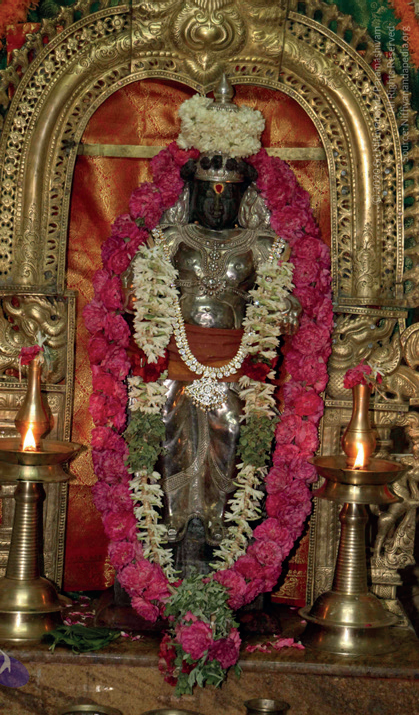
SRI TIRUJNANASAMBANDAR Incarnation of born in Sirkazhi reviver of SSJP in the lineage of Gurumahasannidhanams or Pontiffs