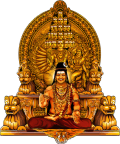
Origin of “Shyamala Peeta Sarvajnapeetha”
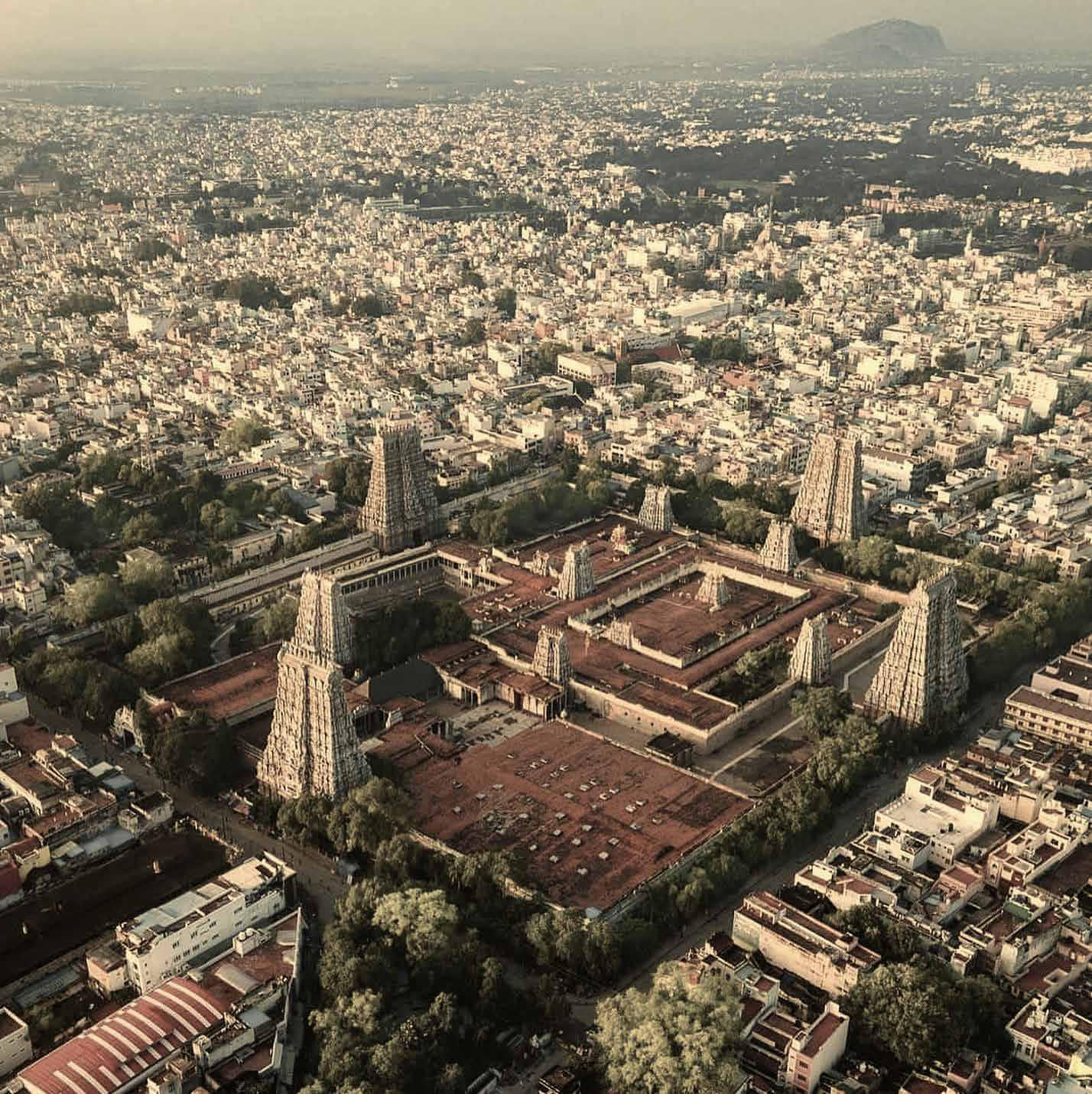
Iraiyanar Sundareśvara established the civilization and founded the protocols of the ways of ancient living based on “Jeevan Mukti” or living enlightenment. The ruling seat of the civilization was “Shyamala Peeta Sarvajnapeetha”. This period was several thousand years before the reign of Devi Mīnākśi. Bhagavān Sundareśvara first established this enlightenment ecosystem and then graced it once again with Devi Mīnākśi several thousand years later
THE SPH Revealations on
“Shyamala Peeta Sarvajnapeetha”.
“With the complete integrity, and authenticity as Devi Mīnākśi Paraśakti and Sundareśvara Paramaśiva, I reveal all the Akashic Records, great Cosmic truths to the whole world, to revive
the original enlightened civilization Kailāsa. The word Kailāsa means source, ultimate source. We all came from Kailāsa. We all have to reach Kailāsa. While we are in this human
frame on the Planet Earth, if we live, radiate the lifestyle of Kailāsa, not only we will be making sure we will be reaching Kailāsa, even while we are living, we will be living Kailāsa. Purpose of life is not only Videha Mukti – achieving liberation after you leave the body; it is Jeevan Mukti – Living Enlightenment. Madurai is Living Enlightenment, Jivan Mukti. One of the greatest successful experiment of Parmashiva – mapping the Kailāsa on Planet Earth is Madurai Shyamala Peetha Sarvajnapeetha. It is such a great powerful success. Nobody could kill it. Its coming back. Its coming back! Its bouncing back! And, it is revived, understand. It is revived. Such powerful experiment. Exactly how in Kailāsa beings are living around Paramaśiva,the same food, clothes, lifestyle, thought currents, inner space, everything as it is – Paramaśiva mapped it to Planet Earth’s conditions and the physicality. The frame of Planet Earth, for that Paramaśiva mapped it; that civilization is Madurai civilization. That peetha (ruling seat) is Shyamala Peetha Sarvajnapeetha. Its one of the greatest successful experiment of Paramaśiva, of course. Its such a great success, no one can kill it. No one can kill it. It’s alive and its bouncing back now to show to the world the Kailāsa culture. Understand, Gopikas enjoyed the romance of Paramaśiva through Kṛṣṇa. Varanas enjoyed the sacrifice, dedication, devotion of Paramaśiva through Rama. Ṛṣis and Munis, Kashivasis, Ṛṣis and Munis who lived in Kashi enjoyed the power manifestation, tapas – Tapoloka, the powers of Tapoloka and tapas of Paramaśiva through Vishwanatha. The Maduraivasis enjoyed all the three. Romance of Gopikas, devotion and dedication of Varanas, powers of Kashivasis, Kashivasi Ṛṣis. Madurai citizens enjoyed all the three together with Mīnākśi-Sundareśvara. Its the greatest civilization.”
Kingdom of Shyamala
Peetha Sarvajnapeetha
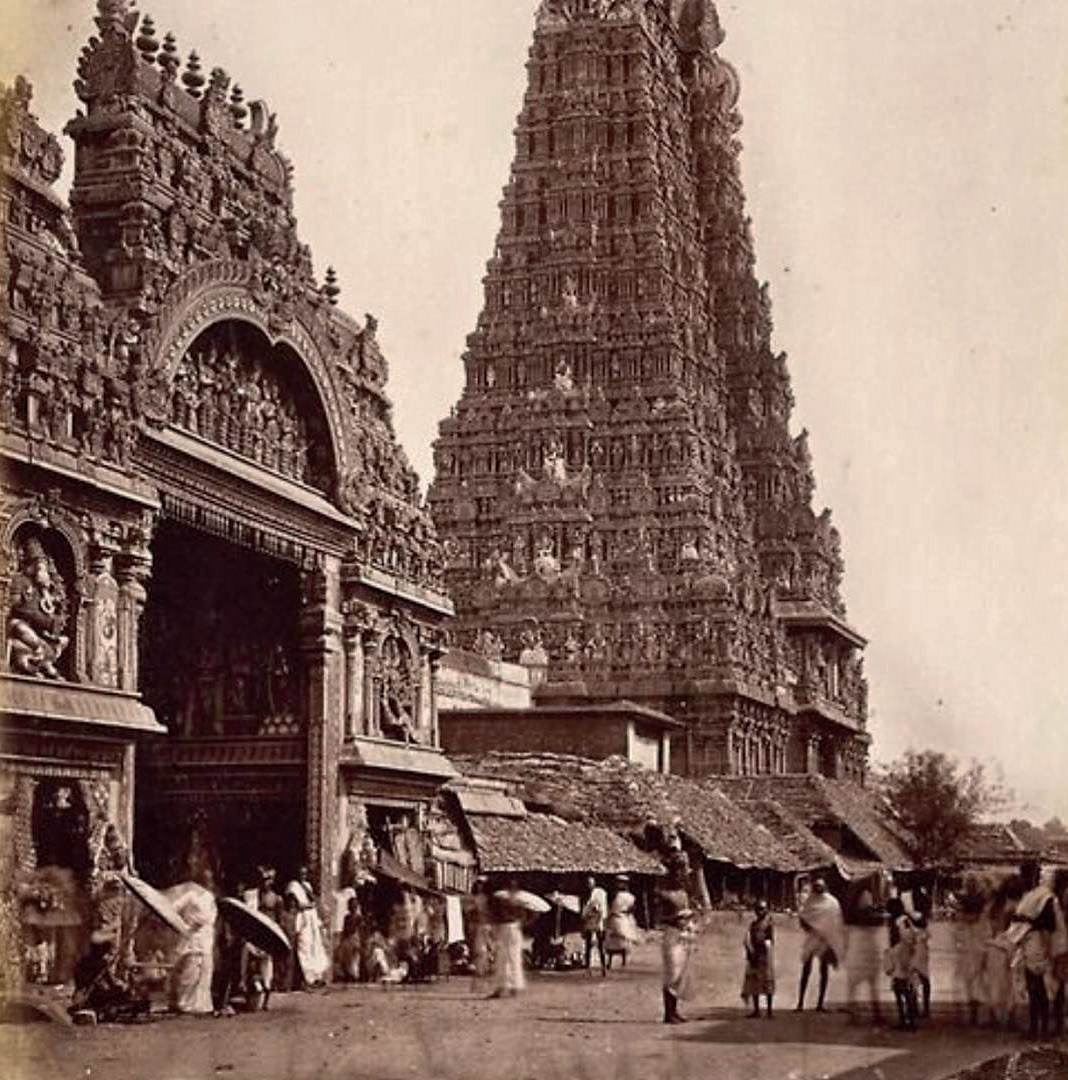
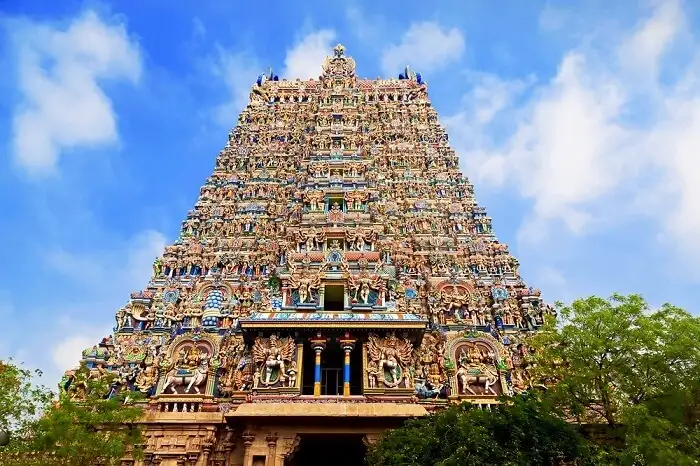
The Kingdom of Shyamalapeetha Sarvajnapeetha was a religious kingdom from its establishment, with Madurai as its capital. It always considered its spiritual head as its political, economical, and cultural head. The political rule (Arasatchi) could not be separated from the economic rule (Porulaatchi), and neither of these can be separated from the core principles of the land. The Pāndyas considered Kamika Āgama (scriptures on the science of living an enlightened life) written by Paramaśiva as the core spiritual guide for the people and the kingdom.
Thus, the political understanding of the people and the nation could only be made with someone who was a master of the Kamika Āgama, who understood its principles deeply
“The Kingdom of Shyamalapeetha Sarvajnapeetha originated from Paramaśiva Himself as Bhagavān Sundareśvara. When a lineage is started by Paramaśiva, the blessed descendants get the title of “Yogishwara.” Thus, according to tradition, the descendants of Bhagavān Sundareśvara, the Guru Maha Sannidhanams of the Madurai Aadheenam, carry “Yogishwara” in their name. The document at the right is a part of the Mother Document of the Madurai Aadheenam and has a record of the names of the Guru Maha Sannidhanams. The earliest records only exist after the revival of Madurai Aadheenam by Thirujñana Sambandar though the Aadheenam began thousands of years earlier. It shows the first Guru Maha Sannidhanam’s name with the title of “Yogishwara,” indicating that he belongs directly to Paramaśiva’s own lineage.”
Pandya Kingdom’s coronation procedure
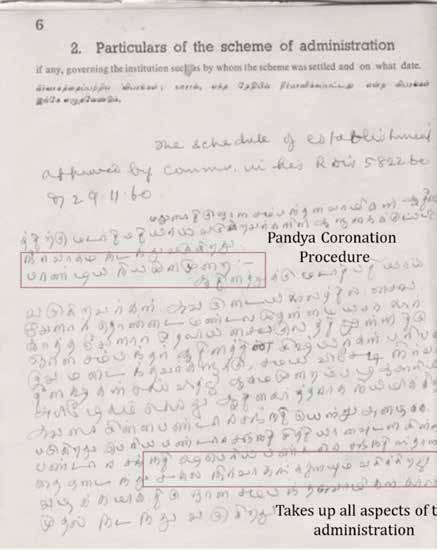
The Madurai Aadheenam was established by Iraiyanar Sundareśvara in the period of its genesis and revived by Mīnākśi much later. Since then, the policies of the Madurai Aadheenam have been preserved and protected, through all possible attempts of destruction. Thus, the Madurai Aadheenam’s procedures remain the same as the Pandya Kingdom’s coronation procedure, as the Madurai Aadheenam was from time immemorial essential to the Pāndya kingdom administration.
The Madurai Aadheenam Guru Maha Sannidhanam (Pontiff) was also the default political Head of State of the Pāndya Kingdom, which used to be a Hindu Monarchy. Even in its original “Document
of Incorporation”, the appointment of the Guru Maha Sannidhanam is referred to as “Pandiya niyamana murai” or the “Pāndya Coronation Procedure.” The next Guru Maha Sannidhanam is coronated with a ruling staff and a crown and is given the right to conduct all administration “sakala nirvagankalyum vagikkirath.”
The Mahābhārata Era 3162 BCE
The political, economical and administrative aspects of the Kingdom of Shyamalapeeta Sarvajnapeetha, established in 11,275 BCE, remained the same through the Mahābhārata Era – the most
defining turn of events in history. The historical references of the great Mahābhārata gives us an insight into the real Hindu history which is the true history of the human race.
Pāndya Civilization continued to thrive, as well as other ancient dynasties of Tamil culture and heritage into the post-Vedic period. Burned scriptures and destroyed libraries have veiled the true history of Śri Kṛṣṇa and the divine mother, Mīnākśi, who lived during the same era. This is only mapped and brought to light by The SPH.
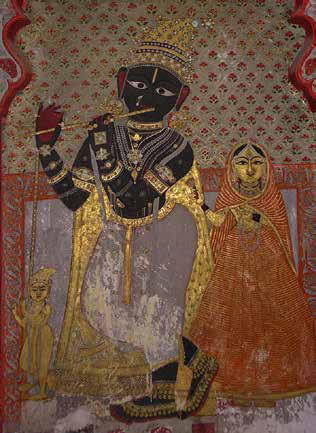
Ancient traditional painting of Bhagavān Śri Ksna and Śri Radha with gold foiling
The SPH on Shyamala Peetha Sarvajnapeetha
For more than ten thousand years, a civilization thrived, giving breakthroughs in human intelligence, and gifting to us in the modern day, the brain capacity to cognize and grasp not just the most advanced technologies, but the ultimate knowledge to transcend the physical realm, the Jnana of Paramaśiva.
“That time Śri Lanka was not a separate land, it was all connected. And, it’s later the ocean came and Śri Lanka came, later on Rama came and built a bridge – all that is much later. This present Madurai and the Kumari Kandam Madurai is one and the same. It’s not different. I saw already in the Cosmic archives. This same Madurai was the Madurai of Kumari Kandam. There are two Madurai, one is south Madurai – the present, this Madurai, and the north Madurai is the Mathura where Kṛṣṇa was. Because Kṛṣṇa was Chandra Vaṁśi, he replicated the whole Pāndya civilization there. That’s why he named it as Mathura. And, that north Madurai was named after this south Madurai. This Madurai is the senior. Throughout the life, Kṛṣṇa lived as embodiment of Mīnākśi and Sundareśvara. I should say Kṛṣṇa’s Ishta Devata is Sundareśvara and Mīnākśi, Mīnākśi and Sundareśvara.
I’ll say Soma Sundareśvara is only worshiped as Somanatha there in his Dvaraka. In his Dvaraka, he installed Somanatha. Soma Sundareśvara only is installed as Somanatha. That’s why in Yadava families, the Mīnākśi name will be too popular. Mīnākśi name will be used in such large level in Yadava families.”
19 June 2019 Akashic Readings by The SPH on Shyamala Peetha Sarvajnapeetha
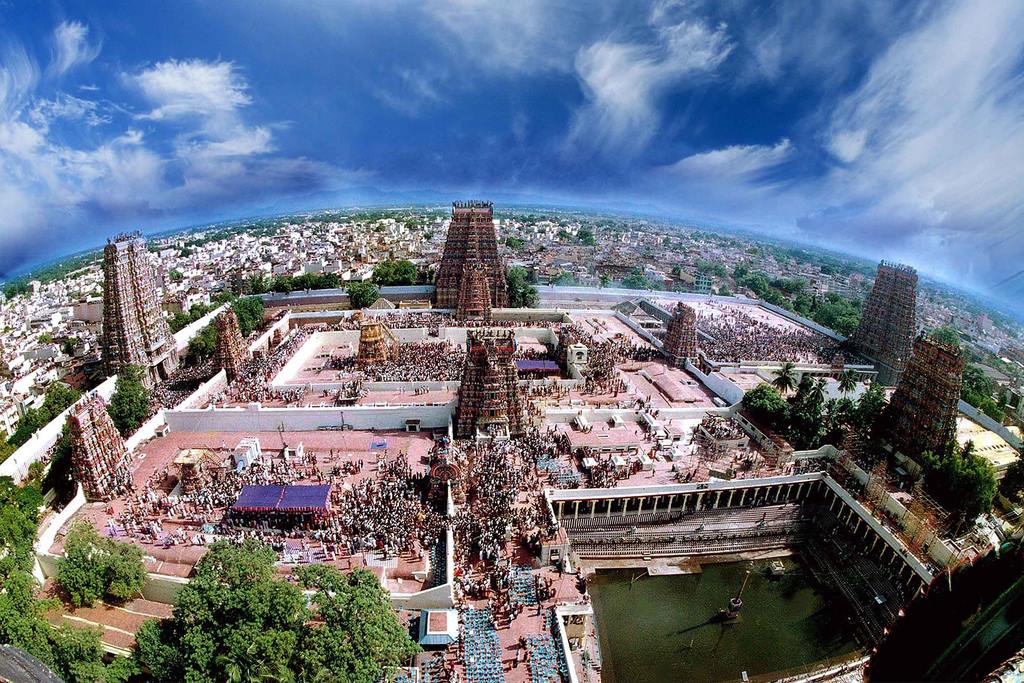

Akashic Readings by The SPH
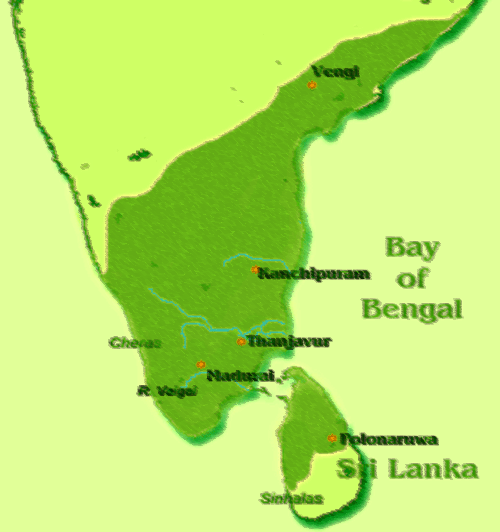
The Kailasa Paramparagatha Shyamala Peetha Sarvajnapeetham, established by Paramaśiva, with its capital at Madurai, ruling the Pandya Kingdom, through the Madurai Aadheenam (ancient temple-monastery), revived by Meenakshi, the Goddess Incarnation and Queen of Madurai, during which time the Pandya kingdom extended its rule over the entire 59 nations that at the time constituted Planet Earth.
In his lifetime, Tiru Jnanasambandar ensured that the lineage established by Paramaśiva was preserved and maintained by His direct heirs and legal representatives – the lineage of Guru Maha Sannidhanams (Pontiffs) of the Madurai Aadheenam.
Being a witness to the growth of human civilization on the planet, the Madurai Aadheenam’s rare and sacred lineage of Masters has been carefully, systematically carried over in an unbroken progression from ages. These chosen emissaries of Paramasiva and Devi, the Guru Mahasannidhanams (Pontiffs) of Madurai Aadheenam are the direct representatives of the Cosmos. They inherit great responsibility in carrying forward the traditions of the Seat. There is no tenure for this position and is a lifetime honor.
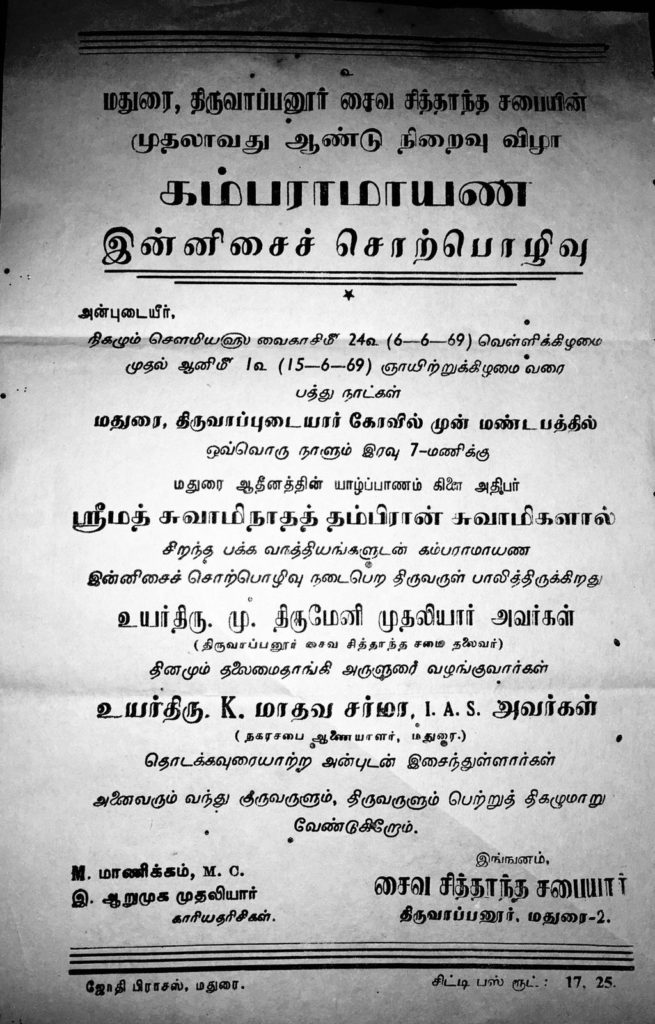
Madurai Aadheenam existed all over the world
Seen in this picture is an invitation printed in Jaffna, Sri Lanka in 1969 by the Jaffna branch of the Madurai Aadheenam, inviting one and all to the traditional musical rendition of the great Hindu epic “Kamba Ramayana” by the Head of the Jaffna branch of the Madurai Aadheenam, Srimad Swaminatha Thambiran Swamigal. Thus, from time immemorial, Madurai Aadheenam and the Gurus of the branch monasteries functioned in various parts of the world keeping alive the enlightenment eco system for the benefit of humanity.
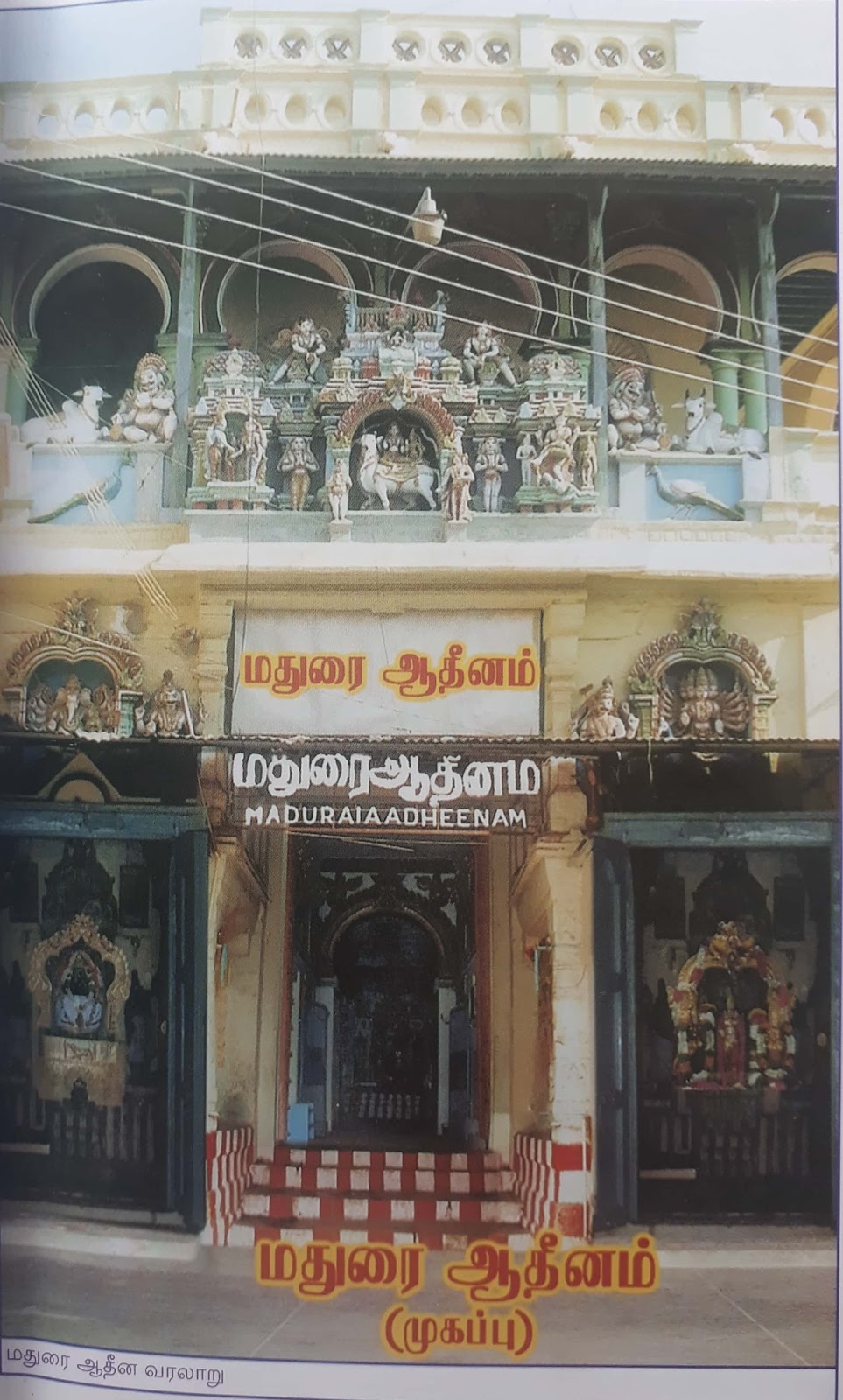
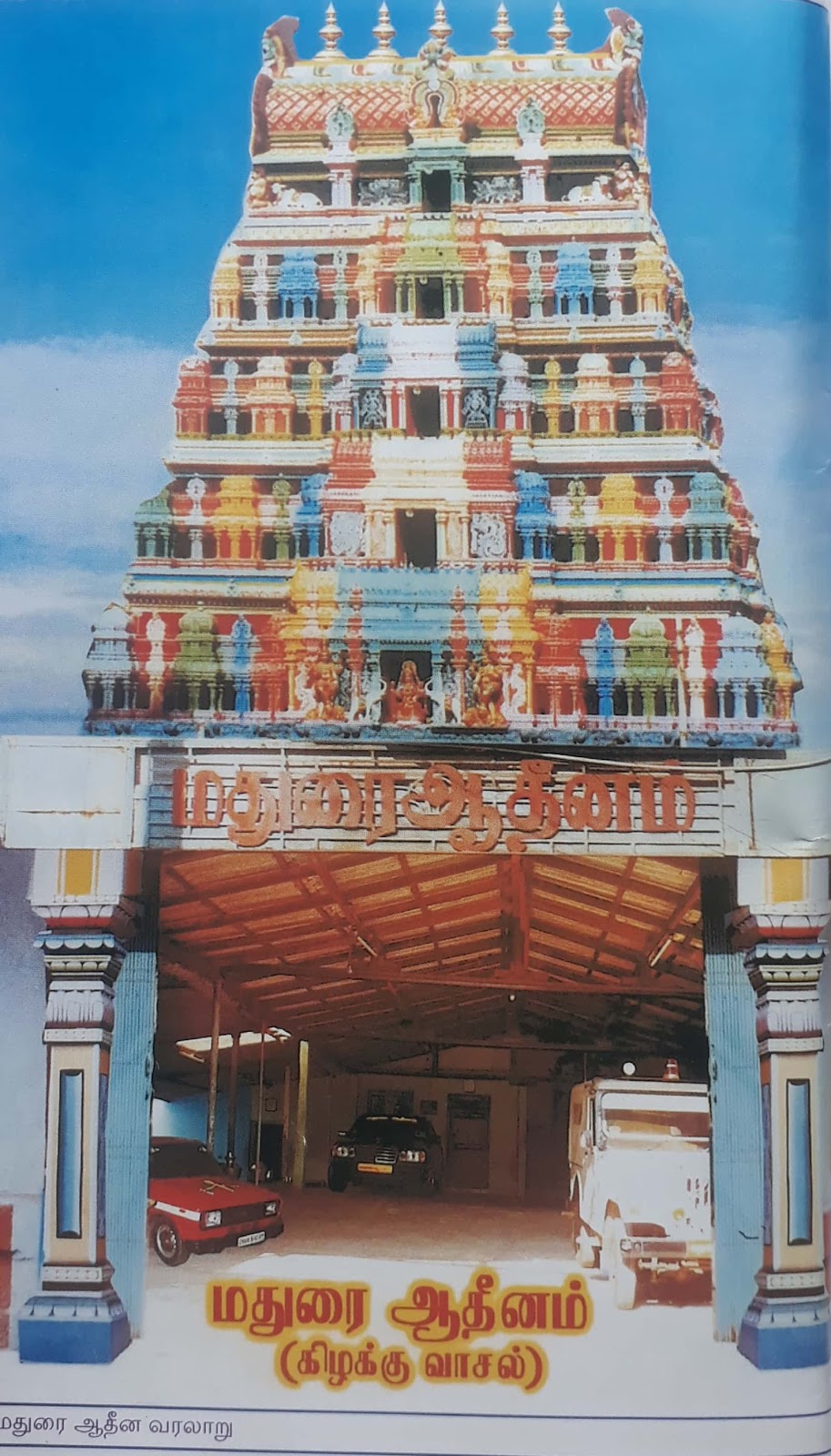
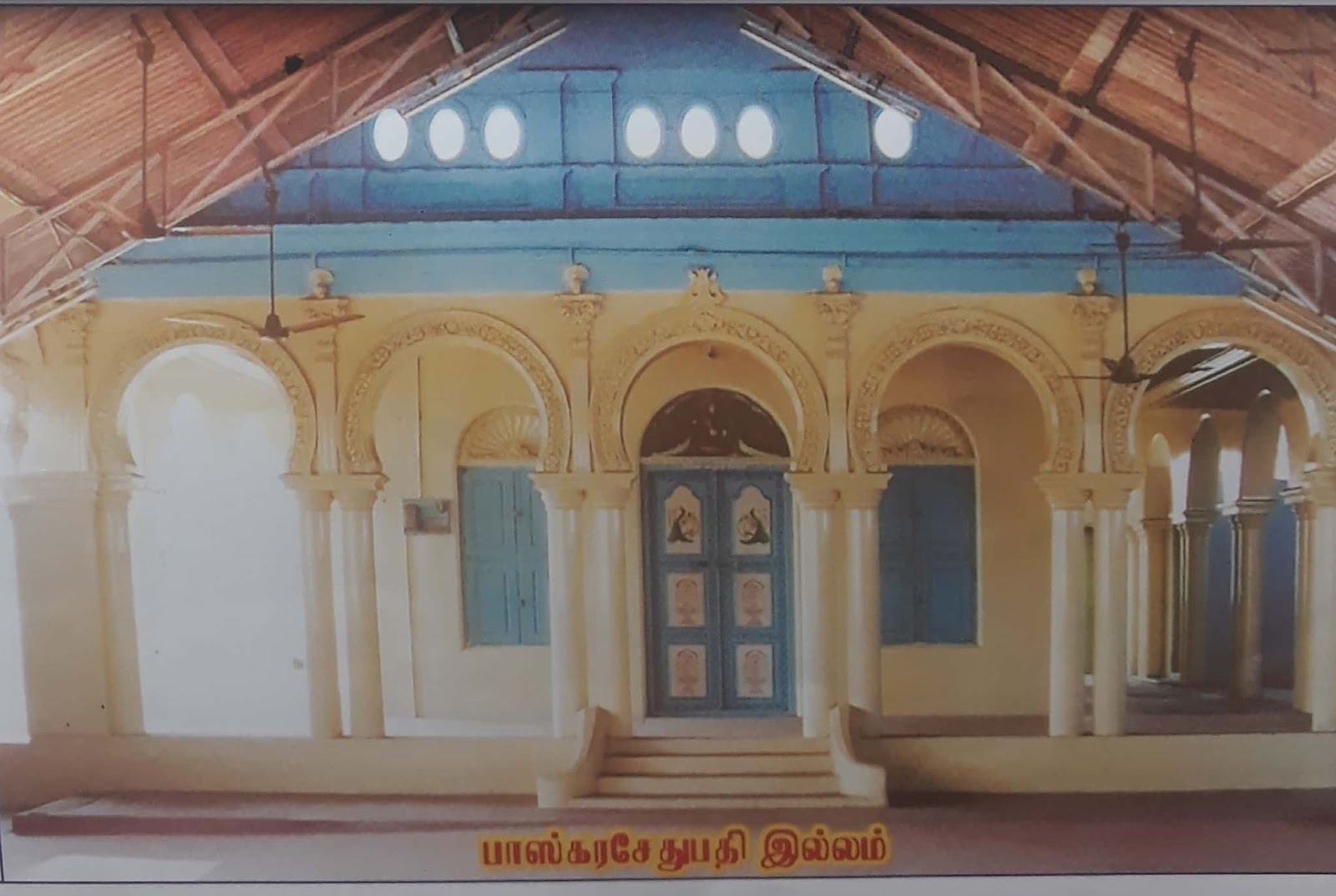
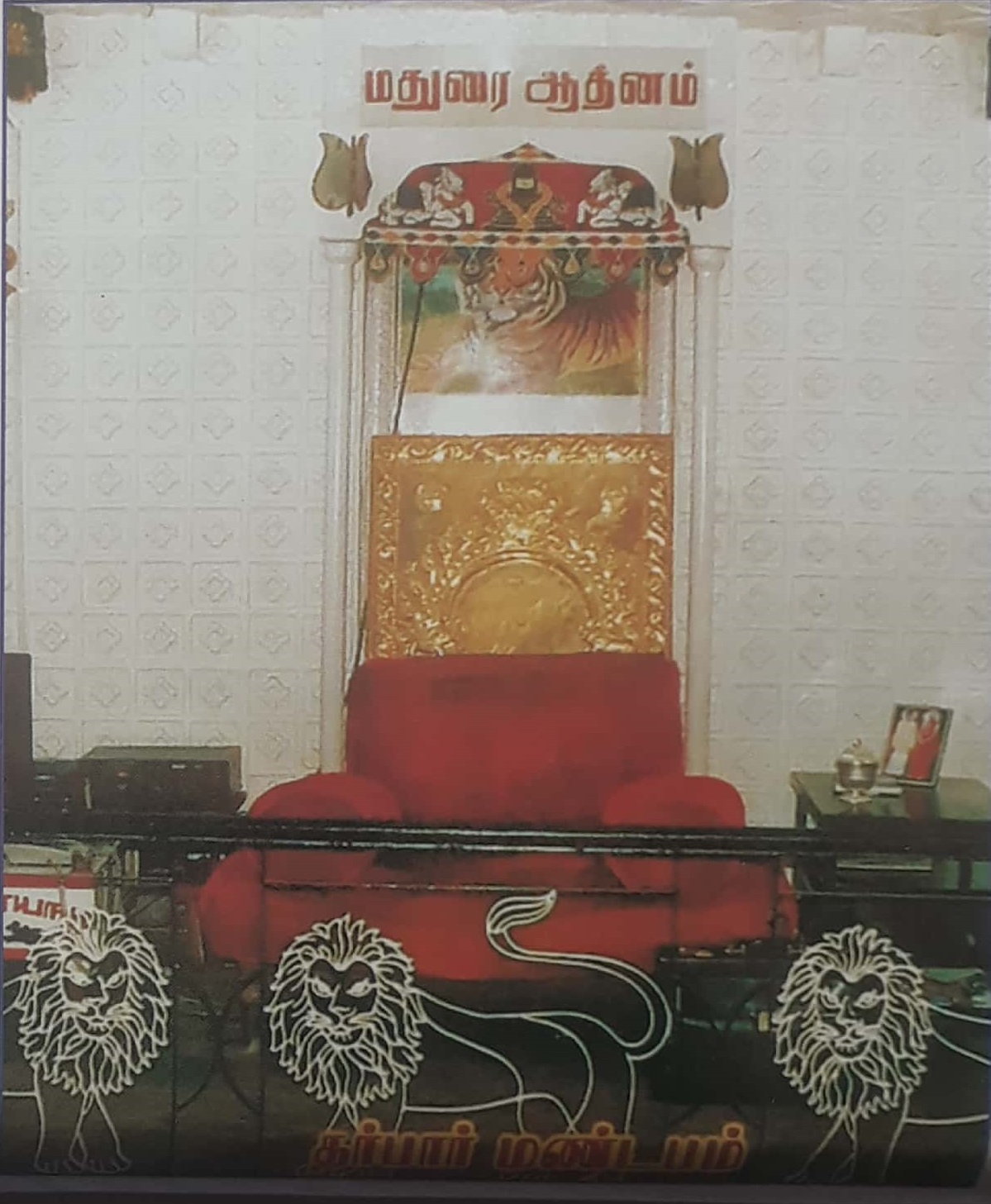
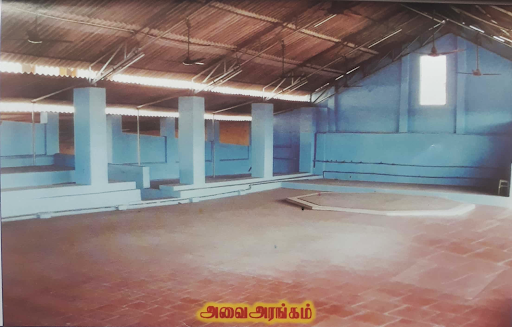
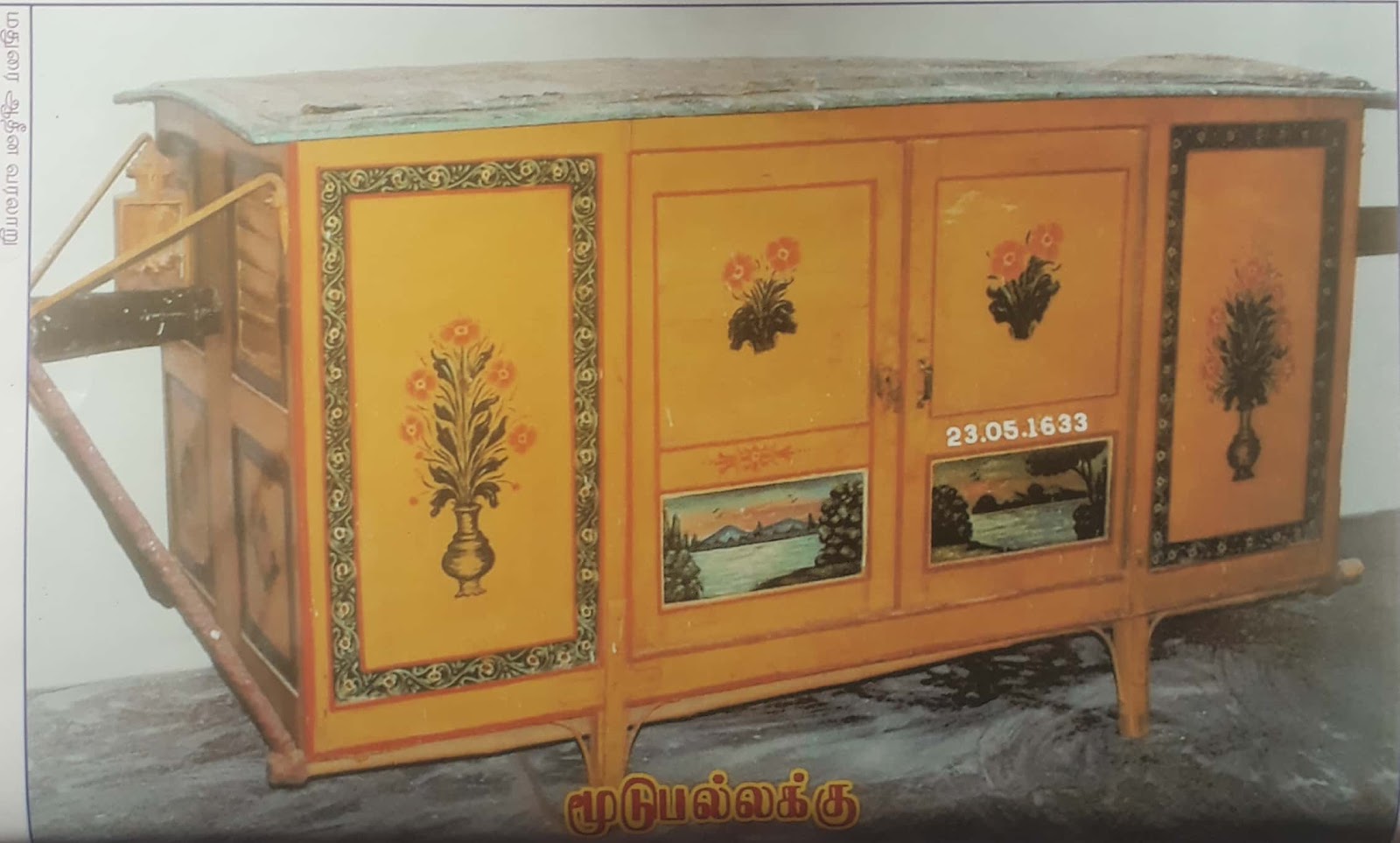
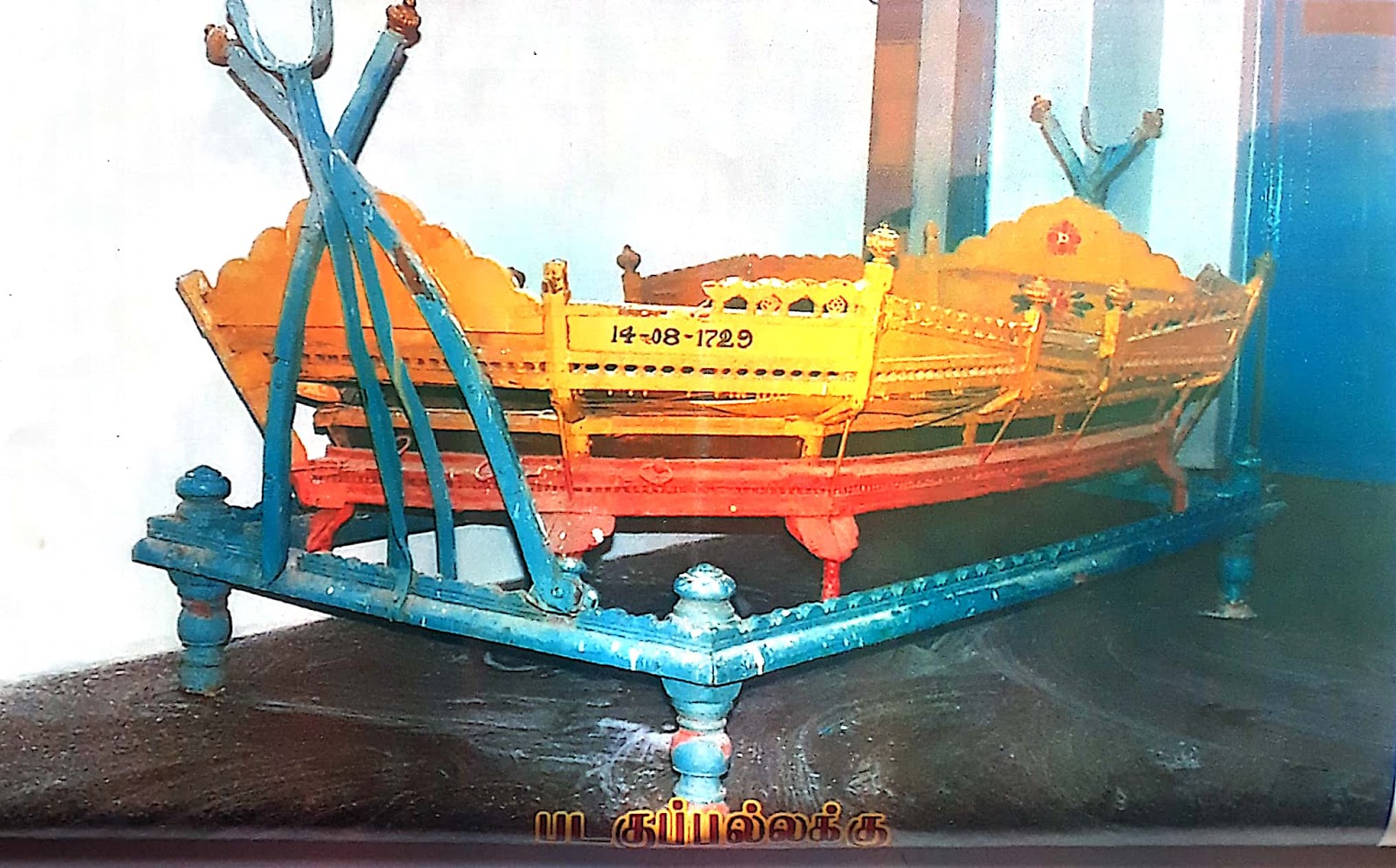
Soverignity
Soverignity
Despite the colonial government’s exploitative strategies, under their rule, some Hindu kingdoms and monasteries, like the Madurai Aadheenam, maintained their sovereignty and the Gurumahasannidhanams were recognized as independent Heads of State. There are many examples showcasing this recognition.
Treatment as the Reigning Monarch
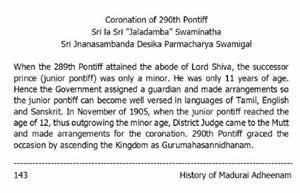
The Regency Acts are Acts of the Parliament of the United Kingdom passed at various times to provide a regent, appointed to govern the state, in the event of the reigning monarch being incapacitated or a minor. When 289th Pontiff of Madurai Adheenam left his body in 1904, his son and successor was only 11 years old. Under the colonial government, the British invoked the Regency Act, used for kings, to take the young Pontiff under their protection. Under the British Empire, the age when a child becomes a major was 12. In 1905, when the child turned 12, his coronation was performed by the District Judge of the Government, and the Kingdom of Madurai was handed back to the Pontiff.
Immunity from Prosecution as the Head of State
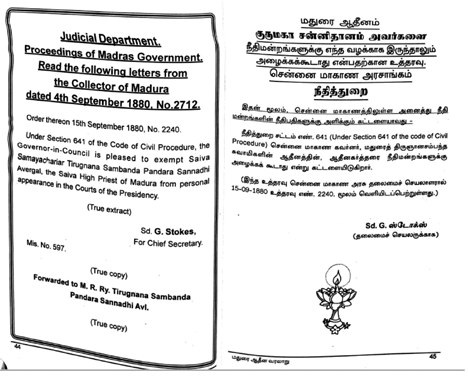
Under many jurisdictions, Heads of State were granted “functional immunity,” protecting them from prosecution during their time in office.Under the British Government, such a recognition was given to the Guru Maha Sannidhanam of Madurai Aadheenam. According to the Judicial Department Proceedings of Madras Government, in the Order dated 15th September 1880, No. 2240, it states ,“Under Section 641 of the Code of Civil Procedure, the Governor-in-Council is pleased to exempt Saiva Samayachariar Tirugnana Sambanda Pandara Sannadhi Avergal, the Saiva High Priest of Madura from personal appearance in the Courts of the Presidency”. This is signed by G. Stokes for Chief Secretary.This shows that heads of the Madurai Aadheenam is also recognized as the heads of the State and is not subject to prosecution, or appearance in front of a court.
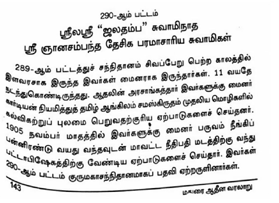

The extract from Madurai Aadheenam History, showing that the British Government applied the Regency Act to the 290th Guru Maha Sannidhaanam
Honor as the Head of State
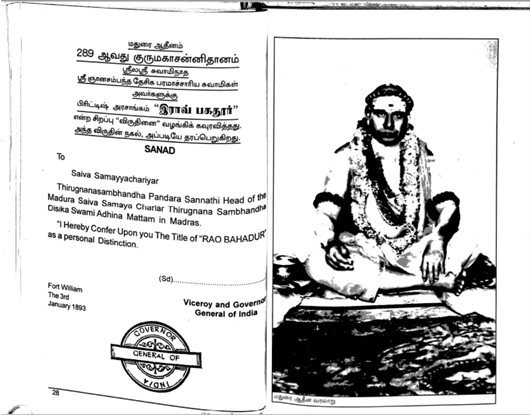
Rao Bahadur, abbreviated R.B., was a title of honor bestowed during British rule in India mainly to Head of States (Kings, Governor).Translated, Rao means “prince”, and Bahadur means “brave” or “most honorable.”The Rao Bahadur title, conferred to Rulers of the Kingdom, was given to the 289th Pontiff of the Madurai Aadheenam, recognizing the status of Guru Maha Sannidhanams as the rulers of the Kingdom of Madurai by the British.
Protection & Immunity as a Traveling Head of State
The British also accorded the head of Madurai Aadheenam protection equivalent to a Head of State while traveling to and returning from other states.An extract of a ruling in 1827 granted by R. Peter, the Magistrate. It states that while the head of Madurai Aadheenam travels to Salem and Coimbatore he is accorded complete protection.
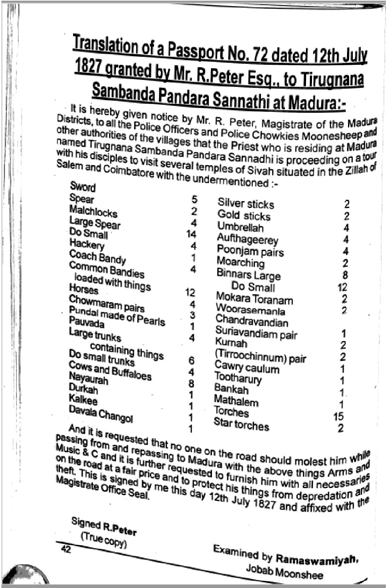
An extract of a ruling in 1827 granted by R. Peter, the Magistrate. It states that while the head of Madurai Aadheenam travels to Salem and Coimbatore he is accorded complete protection.